Selasa, 08 November 2011

XM-26 LSS (lightweight shotgun system) (USA)

Early variation of the XM-26, mounted below the barrel of the M4A1 carbine.
 Early variation of the XM-26, mounted below the barrel of the M4A1 carbine.

 the latest (current) version of the XM-26 LSS mounted under the M4A1 carbine.
 the latest (current) version of the XM-26 LSS mounted under the M4A1 carbine.

 XM-26 LSS with detachable pistol grip / shoulder stock and hand guards, to beused as a standalone weapon.
 XM-26 LSS with detachable pistol grip / shoulder stock and hand guards, to beused as a standalone weapon.

XM-26 LSS as a stand-alone shotgun weapon, with box magazine inserted.
 XM-26 LSS as a stand-alone shotgun weapon, with box magazine inserted.

Type: manually operated, straight pull bolt action
Gauge: 12
Length: 420 mm as an attachment weapon; 610 mm as a stand-alone weapon(with stock collapsed)
Barrel length: n/a
Weight 1.02 kg as an attachment weapon; 1.9 kg as a standalone weapon
Capacity: 5 rounds in detachable box magazine

The XM-26 Lightweight Shotgun System has been in development at the US Army's Soldier Battle Lab since late 1990s. These shotguns are manufactured by the C-More Systems company. Theidea was to provide soldiers with lightweight accessory weapon, which could be mounted under the standard issue infantry rifle (M16A2 or M4A1 carbine), and provide soldiers with additional capabilities, such as: door breaching using special slugs; very short-range increased lethality, using 00 buckshot; less-lethal capabilities using tear gas shells, rubber slugs and buckshot, and other less-lethal rounds.The original idea has been based on the Masterkey system, dated back to 1980s,which originally included the shortened Remington 870 shotgun mounted under the M16 rifle or carbine. The XM-26 improved the original Masterkey concept with the detachable magazine option and more comfortable handling, thanks to bolt-operated system. Detachable magazine offers quicker reloading and more rapid ammunition type change; the relatively large bolt handle is located closer to the rear, than the slide on the pump-action shotgun in the Masterkey configuration, and thus is more comfortable to cycle in combat. Bolt handle could be mounted on either side of the weapon. At the present time small numbers of XM26 LSS shotguns are issued to US troops in Afghanistan, and, according to available sources, these  weapons are well received by troops who used them. It is believed that XM-26 will be compatible with the next US assault rifle, the XM8.
XM-26 is a modular, manually operated, straight pull bolt action shotgun. The barrel is locked [probably] using the rotating bolt, the bolt handle could be mounted on either side of the bolt for ambidextrous handling. XM-26 is fed using detachable box magazines which hold five rounds of 12 gauge ammo. Short barrels are fitted with special muzzle devices. By default, XM-26 has no sights; when mounted under the rifle or carbine, shooter uses rifle sights to aim the attached shotgun. When XM-26 is used in standalone mode, it is equipped with detachable pistol grip and M4-style collapsible buttstock, and small handguards around the barrel. integral Picatinny rail on the top of the XM-26 receiver cant hen be used to mount various sighting equipment.
Special thanks to Kevin Kyle for information

By firearm.com

Winchester 1300 Speed Pump shotguns

Winchester 1300 Speed Pump shotguns (USA)

Winchester 1200 shotgun(Defender model), which was the base of Winchester 1300 design.
 Winchester 1200 shotgun(Defender model), which was the base of Winchester 1300 design.

Winchester 1300 Speed Pump shotgun in traditional hunting configuration.
  Winchester 1300 Speed Pump shotgun in traditional hunting configuration.
Image © Winchester

Winchester1300 Camp Defender shotgun with rifle-type sights, early version.
 Winchester1300 Camp Defender shotgun with rifle-type sights, early version.
Image © Winchester

Winchester1300 Coastal Marine shotgun with corrosion-resistant finish, 7-round magazine and fiber-optic front sight.
  Winchester1300 Coastal Marine shotgun with corrosion-resistant finish, 7-round magazine and fiber-optic front sight.
Image © Winchester

Winchester1300 Defender shotgun, current production (2007) version.
 Winchester1300 Defender shotgun, current production (2007) version.
Image © Winchester

Type: Pump action shotgun
Gauge: 12; Chamber 76mm  / 3"
Weight: 3.06 kg / 6.7 lbs to 3.18 kg / 7 lbs
Length:1003mm / 39.5" to 1245 mm / 49"
Barrel length:457 mm / 18" to 711 mm / 28"
Capacity: 4,5or 7 rounds

The Winchester 1300 shotgun was first introduced in around 1981, when the US Repeating Arms Company (USRAC) took over production of the 'Winchester' brand gunsfrom the Olin / Winchester corporation. In fact, the model 1300 was a slightly modified version of the previous Winchester model 1200 shotgun, which was manufactured by Olin /Winchester between 1964 and 1980. With recent (mid-2007) closure of the USRACfactory production of the Winchester model 1300 shotguns, along with other Winchester brand guns, was moved to Winchester Repeating Arms Co; new guns will be manufactured by one of the FN ManufacturingCo subsidaries located in the Morgan, Utah.
 The Winchester1300 shotguns are also known as the 'Speed pump', because of the very fast-cycling pump action, which makes these guns popular among both hunters and sportshooters. These shotguns also work well for home defense and security applications, especially with availability of relatively short-barreled models with long magazines.
The Winchester 1300 shotgun utilizes so called pump action, which is operated by sliding for end. For end is connected with bolt group with dual action bars. Receiver is produced from lightweight aluminum alloy, and the bolt locks into the barrel extension using a rotary bolt head with four radial locking lugs. Feed is from tubular under barrel magazines, which can be had in a variety of lengths / capacities. Barrels are quick-detachable; in 'Defender' configurations barrels have fixed cylinder choke; in hunting configurations barrels are usually fitted with replaceable chokes and a sighting rib. Standard furniture comes in wood or plastic varieties, finish and sights may vary from version to version.

Jackhammer shotgun (USA)

Jackhammer shotgun (USA)

Jackhammer Mk3A1.
 Jackhammer Mk3A1.
image source: Jane's Defense Library 2000 CD-ROM

Jackhammer Mk3A1 - rear view.
 Jackhammer Mk3A1 - rear view.
image source: Jane's Defense Library 2000 CD-ROM

side and front views drawing from the original patent (1984 -1987). Note that the appearance of the original design differs from the latest Jackhammer Mk3A1 shown above.

Jackhammer exploded parts diagram from the original patent.
 Jackhammer exploded parts diagram from the original patent.

Type: gas-operated, select-fire
Gauge: 12
Length: 787 mm
Barrel length: 525 mm.
Weight unloaded : 4.57 kg
Capacity : 10 rounds in removable revolver-type drum magazine
Rate of fire: 240 rounds per minute

The Jackhammer automatic shotgun was developed by the US firearms designer John Andersen, who requested patents for the basic design of this shotgun in 1984. Since that time and until the late 1990s he continued to develop and improve his basic design but as far as I know failed to attract any serious buyers. In fact, only few working prototypes of the Jackhammer were ever built. Some sources stated that only two fully automatic prototypes are exist, and the Jane's Defense Library 2000 stated that the development is complete but production never began. At my opinion, the Jackhammer is a solution that still to have a question, and it possess some questionable features that can distract any serious military or police buyer. But, anyway, it is interesting design and well deserves its place both here and in the general firearms history.
The Jackhammer is a gas operated, fully automatic only shotgun. The gas system of the Jackhammer consists of the gas cylinder, formed around the movable barrel. The gas piston is formed by the collar, fixed to the barrel just ahead of the gas port that feeds the gases from the barrel into the gas cylinder. When gun is fired, the powder gases are fed into the gas cylinder and began to push the gas piston and the whole barrel to the front, against the pressure of the return spring. The return spring is located around the barrel, ahead of the gas piston. When barrel moves forward, it first disconnects itself from the chamber with fired cartridge, and then, continuing to move forward, operates the action rod that connects the barrel and the feed and firing system. The action rod reciprocates with the barrel and has two downward projections on its rear end. These projections act on the cam slots, cut on the outer surface of the cylinder that contains the ammunition. When barrel and action rod go forward, the forward projection on the action rod rotates the cylinder 12o clockwise. On the backward strike of the barrel and action rod the rear projections rotates the cylinder another 12o to align next chamber with the barrel. At the final stage of the cycle rear part of the barrel reconnects itself with fresh chamber to achieve a gas-tight connection. At the same time the rear part of the action rod engages the striker, located behind the upper chamber of the cylinder, and cocks it. If the trigger is still pulled all the way back when the reloading cycle is completed, the sear will be released automatically and gun will fire again. There is no provisions for the dedicated semi-automatic single-shot mode - due to the relatively low rate of fire the single shots can be obtained by the quick pulls on the trigger. The feed system consists of the 10 shot, revolver type detachable cylinders, named "Ammo Cassette". The cassette may have 10 chambers for more or less conventional 12 gauge shotgun shells, or may be designed like the "cap and ball" era revolver cylinders. In the latter case, each chamber is factory pre-loaded with powder, primer and a projectiles of one or another type, then hermetically sealed in the plastic film cover. Prior to load the "Ammo Cassette" into the gun, one must remove the plastic sealing and then insert the cassette. When all charges from the cassette are fired, it can be disposed of or sent to the factory for reload. The manual cocking for the first shot and the magazine replace process are controlled by the sliding forward handguard. When the handguard is pulled forward, it engages the barrel and pulls it forward and then back, to cycle the action. To remove the Ammo Cassette, one must pull the trigger half the way back (presumably with the safety engaged), and then pull the handguard forward. This will withdraw the barrel from contact with the chamber of cassette and then remove the cassette axis forward, so the ammo cassette will be free to fall out of the gun. In the forwardmost position the slide will be automatically held by the release latch, located at the front of the handguard, thus leaving the shooters' non-firing hand free to insert the fresh "cassette" into its place. As soon as the ammo cassette is in its place, the shooter must push the slide release, so the barrel and the slide will go back under the pressure of the return spring, locking the cassette in place and cocking the gun. The striker can be manually cocked or de-cocked using the cocking handle, located inside the butt. The barrel of the Jackhammer can be easily replaced by removing the muzzle cover and return spring, then rotating barrel 90o either side do disconnect if from the action rod and, finally, pulling the barrel out of the gun. The new barrel then could be dropped in and rotated 90o to engage with the action rod. Then goes the return spring and the muzzle cover. The conventional open sights are mounted within the integral carrying handle.

Courtesy by Secret Firearm

L129A1 Sharpshooter rifle / LMT LW308MWS (USA / UK)

L129A1 Sharpshooter rifle / LMT LW308MWS (USA / UK)

L129A1 Sharpshooter / Sniper rifle, as issued to British army; optics removed, backup iron sights in combat position.
 L129A1 Sharpshooter / Sniper rifle, as issued to British army; optics removed, backup iron sights in combat position.

L129A1 Sharpshooter / Sniper rifle, as issued to British army, withTrijicon ACOG 6X48 telescope sight and additional close-combat Docterred dot above it.
 L129A1 Sharpshooter / Sniper rifle, as issued to British army, withTrijicon ACOG 6X48telescope sight and additional close-combat Docterred dot above it.

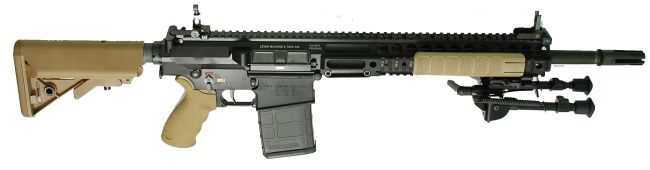
 LMT LW308MWS (LM7) rifle, the commercially available precision rifle which isthe base for the British L129A1 weapon.
 LMT LW308MWS (LM7) rifle, the commercially available precision rifle which isthe base for the British L129A1 weapon.

Caliber(s): 7.62mm NATO (.308Win)
Operation: gas operated semi-automatic
Barrel: 406 mm / 16"
Weight: 4,5 kg
Length: 900 - 990 mm
Feed Mechanism: 20 rounds detachable box magazine

The L129A1 Sharpshooter / Sniper rifle was born fromthe urgent requirements that came from the British forces deployed toAfghanistan. This requirement was based on the tactics employed bytheir opponents, who prefer to fire at convoys and foot patrols fromstand-off ranges (usually 500 meters or more), using 7,62mm rifles andmachine guns. The standard issue 5,56mm weapons (L85A2 rifle, L86A2 LSW, FN Minimi LMG), whichare used by British troops, are mostly ineffective at these ranges,,and a call was made for a semi-automatic rifle, chambered for 7,62x51NATO ammunition, which is capable to engage individual targets atranges of up to 800 meters. These rifles are intended for use on thesquad and platoon levels, to support small units operating 'on foot'and away from fire support bases and armored vehicles. Basically, it'sthe same concept which during the last 50 years was employed by Soviet and is still employed byRussian army, which issues 7,62x54R SVD marksmen / sharpshooter riflesto every infantry squad.
The new weapon, which is now officially issued to British troops asL129A1 Sharpshooter rifle, was selected through competitive trials,which included four 7,62mm semi-automatic weapons - HK 417 from Germany, FN SCAR-H Mk.17 fromBelgium, Sabre Defense XR-10 from US/UK and LMT LW308MWS (also known as LM7) from USA. Thelatter weapon, built in USA by Lewis Machine & Tool Co and distributed in UK by LEI Ltd, won thecompetition. Initial order was for some 440 rifles, and many of theseweapons are already in use by British army in Afghanistan.
The L129A1 Sharpshooter / Sniper rifle is a gasoperated, semi-automatic weapon. It is based on the famous Stoner AR-10 rifle,anduses similar direct impingement gas action, rotary bolt locking andoverall design. The upper receiver is made integral with monolitic railplatform forend, which surrounds free-floating barrel made of stainlesssteel. Front of the barrel is fitted with Surefire flash hider /suppressor adapter. The lower receiver is fitted with ambidextrouscontrols (safety and magazine release). Rifle is equipped with LMT'sSOPMOD adjustable telescoping buttstock. Feed is from 20-round Knight'smagazines.Standard issue sight for L129A1 rifle is the Trijicon ACOG 6x48telescope with ballistic drop compensating reticle for 7,62NATOammunition. Additional folding back-up iron sights are provided. Allsighting equipment is installed using standard Picatinny railinterface. Available information suggests that the L129A1 rifle candeliver MOA accuracy with standard ball ammo, and under fieldconditions it is capable of routinely hitting man-size target at rangesof up to 800 meters (assuming that the shooter is up to the task aswell). According to the mission profile, rifle can be equipped with anumber of accessories, such as folding bipod, quick-detachable soundmoderator (silencer) or a 40mm M203 underbarrel grenade launcher.

            : - D                      : - )          

Modern Firearm.com

Sniper all type

Barrett XM500 long range sniper rifle (USA)

Barrett XM500 long range sniper / anti-material rifle.

Caliber: .50BMG (12.7x99mm)
Operation: gas operated, semi-automatic
Barrel: n/a
Weight: 11.8 kg
Length: 1168 mm (46")
Feed Mechanism: 10 rounds detachable box magazine

XM500 rifle is the most recent creation of famous American Barrett Firearms co. This rifle, first shown in 2006, is intended to provide lighter and more compact alternative to popularBarrett M82 "Light fifty" rifle,which is widely used by military and law enforcement forces around the world.The new weapon will provide better accuracy (because of stationary,non-recoiling barrel) and same range as Light Fifty, while being lighter and significantly shorter, thanks to its bullpup layout. According to available information, this rifle is developed primarily for US Armed forces, and is still in development / prototype stage.
Barrett XM500 long range sniper / anti-material rifle is a gas operated,semiautomatic rifle. Gas chamber and piston are located above the barrel. Barrelis locked using rotary bolt. Stock is of bullpup layout and made of metal, with rubber buttplate. Rifle is fitted with detachable lightweight bipods, adjustable for height. There are no open sights as of now, but rifle is fitted with integral Picatinny rail on the top of the receiver, so any type of sights can be installed using appropriate mounting interfaces.

Courtesy by Firearm.com

Chey tac in 408 caliber

CheyTac Long Range Rifle System  - Intervention sniper rifle (USA)

 CheyTac Intervention .408 caliber M100 sniper rifle.
 CheyTac Intervention .408 caliber M100 sniper rifle.

 CheyTac LRRS, including Intervention M200 rifle with scope, .408 CheyTac ammunition, andtactical ballistic computer.
 CheyTac LRRS, including Intervention M200 rifle with scope, .408 CheyTac ammunition, andtactical ballistic computer.

Close-up view on the receiver and controls of the CheyTac Intervention M200rifle. Note large carrying handle under the barrel sleeve, and the scope fittedwith IR night vision module and IR laser.

CheyTac Intervention M200 rifle in the carrying case.
 CheyTac Intervention M200 rifle in the carrying case.

CheyTac Intervention M310 single shot Target / Law Enforcement rifle.
 CheyTac Intervention M310 single shot Target / Law Enforcement rifle.

.408 CheyTac cartridge (middle) compared to .50BMG (left) and .338Lapua (right).
 .408 CheyTac cartridge (middle) compared to .50BMG (left) and .338Lapua (right).

Caliber: .408 CheyTac
Operation: manually operated rotating bolt action
Barrel: 762 mm (30")
Weight: 12.3 kg
Length: 1400 mm (stock retracted), 1220 mm (stock collapsed)
Feed Mechanism: 5 rounds detachable box magazine

The entire idea behindthe CheyTac LRRS (Long Range Rifle System) is to provide long range soft targetinterdiction (read: anti-personnel sniper) rifle package, with maximum effectiverange, but relatively compact and light. To achieve this goal, the professor John D. Taylor designed the .408CheyTac cartridge. Being mid-way in size between the mighty .50BMG and alreadyestablished long-range favorite .338Lapua, the .408 features a streamlinedbullet with advanced patented design. This design allows the standard 419 grain (27.15gram) bullet to retain its supersonic velocityat the ranges beyond 2000 meters (2200 yards). At the ranges beyond 700 meters the .408 bullet has more energythan the standard .50BMG ball bullet. The .408 cartridge also is lighter than.50BMG cartridge by about 1/3, and generates less recoil. 
The original CheyTacIntervention M100 rifle is based on the Windrunner .50 caliber takedown rifle fromEDM Arms. Current Intervention M200 sniper rifles still are based on Windrunnerdesign, but with several modifications. The Long Range Rifle Systemalsoincludes CheyTac tactical computer (commercial PDA with CheyTac ballisticsoftware), Nightforce NXS 5.5-22X scope, and Kestrel 4000 wind/temperature/atmosphericpressure sensors, linked to the PDA. The Tactical Computer with sensors andinternal ballistic database provides all necessary data for long range fire.CheyTac papers state that the entire System is capable to deliver sub-MOAaccuracy at the ranges of up to 2500 yards (2270 meters).
The Intervention M200is a manually operated, rotating bolt rifle. The retractable buttstock allowsfor adjustment of the length of pull, and can be fully collapsed for storage andtransportation. The barrel can be quickly removed for replacement, or storageand transportation. The butt contains integral real monopod, which is hinged,and can be folded up when not in use. The heavy, fluted barrel is free floated,and its rear part is enclosed by tubular shroud, which serves as a mount forintegral folding bipod and carrying handle. Barrel is provided with effectivemuzzle brake, which can be replaced with OPSINC suppressor (silencer). M200rifle is fed using detachable single stack magazines, which hold 5 rounds. Topof receiver is fitted with permanent MilStd Picatinny rail. Standard scope isNightforce NXS 5.5-22X, which can be upgraded with AN/PVS-14 Night Vision moduleand AN/PEQ-2 IR laser. No iron sights are provided with M200 rifle.
CheyTacAssociates also offers a less expensive, non-takedown single shot rifle in .408caliber, the Intervention M310. This bolt action rifle with adjustable polymerstock is suitable for long range sport shooting, as well as for police longrange snipers.
data source: CheyTac Associates TechnicalWhite Papers, 2001-2003, and CheyTac promotional literature.

Courtesy by Modern Firearm